 Armenian AI Company
FNM: a natural-law simulator
Streaming has long carried pixels and sound from strong machines to weak ones. FNM does the same for physics: a thin client sends a scene, a fleet of parallel solvers computes how nature would move it, and the coordinates stream back — rigid bodies, liquids, heat, gases, and chemical reactions, all solved off the device.
The need
The pattern is everywhere except where it matters most. Cloud gaming renders a frame on a datacentre GPU and streams the picture to a phone that could never draw it; music services keep the library on a server and send only what is playing. In each case the heavy thing stays where the power and storage are, and a thin stream reaches the device.
Physics has almost no equivalent. Rigid-body engines such as Project Chrono resolve mechanics and contact, but not the wider set of natural laws a real scene runs on — fluids that displace and drag, heat that flows toward equilibrium, gases that expand, chemistry that reacts. A game or a training simulator that wants those either bakes them offline or fakes them with shaders. FNM was built to close that gap: to make physics something a thin client can request rather than compute.
What crosses the wire
The contract is deliberately narrow. A Unity client sends the scene: where each object sits, its shape, and its physical properties — mass and density, temperature, viscosity, conductivity, whatever the material and the simulated law require. It sends no code and runs no physics.
The solvers
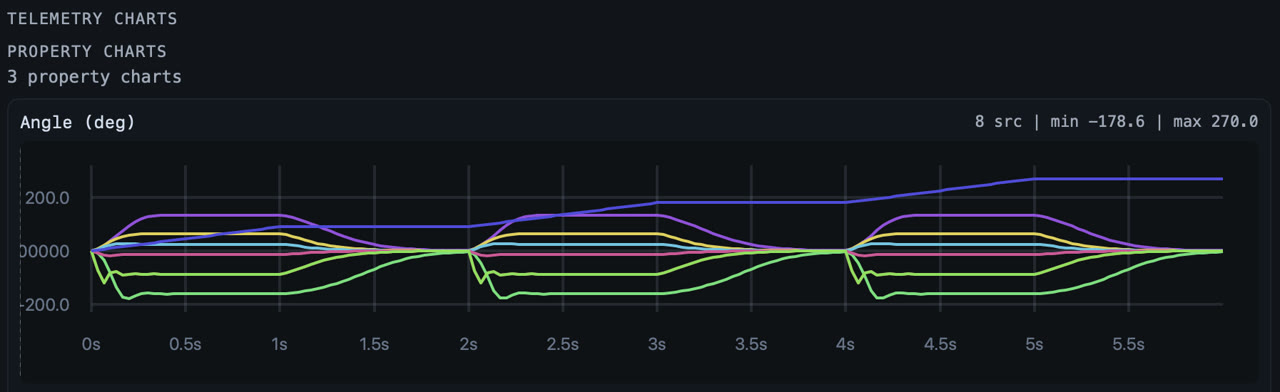
Behind the wire is not one engine but several, each a fast, parallelised solver for one family of law: rigid-body kinematics and contact, incompressible liquid dynamics, heat transfer, gas dynamics, and reaction chemistry. They share the scene and the clock, so a single hand-off can touch more than one at once — ice melting in a warm glass is rigid motion, buoyancy, heat flow, and phase change resolved together. The clips below are the returned state, replayed in the diagnostic viewer.
Cost of the computation
The point of the split is that the expensive half never touches the device. Integration — the timestepping of each law, the contact resolution, the coupling between solvers — runs parallelised on the strong machine and reduces to a compact trajectory table before anything is sent. What crosses the wire scales with the number of sources and the length of the timeline, not with the difficulty of the physics. A device replaying a six-hundred-second melt does as little work as one replaying a two-second roll.
A scene and its materials go in; the coordinates of how nature moves them come back. The device never integrates a law — it replays a table. The heavy work stays where the power is, and physics becomes something a thin client can request rather than compute.