 Armenian AI Company
The keyboard symmetry tax
Every split ergonomic keyboard sold today gives each hand the same number of keys. Nothing about how English is actually typed asked for that split to be even — and a brute-force search across 61,000 words puts the alphabet’s true alternation-optimal break at eight letters against eighteen.
One word, one hand
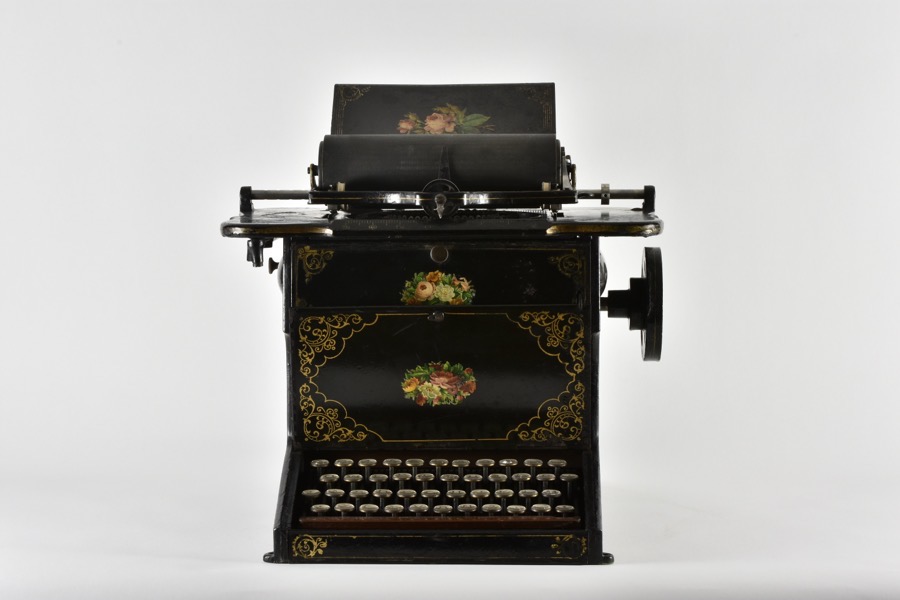
Type the word acetate on an ordinary QWERTY keyboard and every one of its seven letters — a, c, e, t, a, t, e — is struck by the left hand. Start to finish, one hand does the entire word while the other sits still. That failure was never aimed at chemists in particular; QWERTY’s 1873 arrangement was shaped by the mechanical and commercial pressures on early typewriters and their operators, a history whose details historians still argue over, but nobody argues it was chosen to balance two hands’ workload (see the Smithsonian’s history of the layout). But look at where the layouts that were actually designed for typists put the same word. Colemak, the most widely adopted QWERTY alternative, was built by testing candidate arrangements against real English text and keeping whatever scored best against it — its own design notes describe the trouble of finding “a high quality corpus…to get accurate letter/bigram frequency data,” and name avoiding same-finger typing, not maximizing hand alternation, as the primary constraint it optimizes for. Run acetate through Colemak’s own hand assignment and it barely improves on QWERTY: L L R L L L R, five same-hand transitions out of six — because a word that shows up rarely in ordinary English prose earns almost no weight in a frequency-weighted design, however often the one person who actually needs it, a chemist in this case, ends up typing it.
Hand alternation does not have this problem, and the reason is structural rather than a matter of degree. It is not a fact about which words are common; it is closer to a fact about how English spells words at all — vowels and consonants tend to alternate within a word whether the word is common or was coined in a lab last year — so a layout that separates vowels from consonants tends to alternate hands on any word, seen in training data or not. That makes it the one keyboard-design metric that can be optimized without a frequency-weighted corpus at all, and without giving up anything a frequency-weighted corpus would have bought. A plain 61,289-word English dictionary, a brute-force search over every way to split the alphabet in two, and a scorer that simply counts adjacent same-hand letters is enough to find out which split actually maximizes it. The answer is not fifty-fifty. It keeps improving well past thirteen letters on a side, bottoming out at eight against eighteen — and that result runs straight into the one design decision every split ergonomic keyboard on the market makes without appearing to notice it is a decision at all: that the two halves should be the same size.
A metric that doesn’t need to know the word
Every popular alternative to QWERTY shipped in the last forty years was tuned against a corpus: a large sample of real English text, with letters and letter pairs weighted by how often they actually occur in it. That is the right instinct if the goal is to shorten the average keystroke, because ordinary text obeys Zipf’s law—a small number of words and bigrams account for most of what anyone types, and a corpus-weighted optimizer is right to spend most of its effort there. But a corpus has a shape, and everything past its short, dense head is a long, thin tail that a frequency-weighted score barely notices, and the tail is exactly where a working vocabulary lives. Not just acetate: isotope, catalyst, arsenic, chromosome are all common enough in a chemistry or biology department and rare enough in a general corpus that a layout tuned on that corpus was essentially never asked to care how they type.
Across the same 61,289-word list used throughout this piece, Colemak leaves 620 words entirely one-handed, ninety-six of them six letters or longer, including abracadabra, millennium, and — memorably — honeymoon. None of this is a defect in Colemak’s engineering; its own documentation is candid that avoiding same-finger bigrams, not maximizing alternation, is what it primarily optimizes for, and it does that well. It is a demonstration of what frequency-weighting costs whenever a design goal depends on which specific words show up, because whichever words don’t show up enough are, by construction, invisible to the optimizer that was never told to look for them.
Hand alternation sidesteps this because it isn’t a claim about which bigrams are frequent. It is closer to a claim about English orthography itself: syllables need vowels, vowels are heavily outnumbered by consonants in the alphabet, and a word that strings several consonants together before its next vowel is the exception rather than the rule. Put most vowels on one hand and most consonants on the other, and a large share of English words — whatever their frequency — will tend to alternate simply because that is how they are spelled. That is also why this particular optimization can be run without a frequency-weighted corpus at all: score every word in a plain dictionary once, rare and common alike, and the split that wins is close to the split that would win if the scoring were weighted by real-world usage, because the property being rewarded doesn’t depend on usage in the first place. A frequency-weighted search protects the head of the distribution on purpose and the tail by luck, if at all. An alternation search, run unweighted, protects both by the same mechanism.
Why alternation works, mechanically
The claim that swapping hands between keystrokes beats repeating one hand is not new, and it did not wait for computers to test it. August Dvorak and his co-authors spent years filming typists in slow motion and cataloguing English letter combinations for Typewriting Behavior (1936), the book that introduced the Dvorak Simplified Keyboard, and one of its explicit design goals was to maximize alternation between hands, “which makes typing more rhythmic, increases speed, reduces error, and reduces fatigue.” The physical reasoning is simple: while one hand completes a keystroke, the other hand, if it has somewhere different to go next, can already be moving into position — the two motions overlap. Ask the same hand to hit two keys in a row and the second motion can’t start until the first one finishes, because it’s the same hand doing both. A 2016 study of manual coordination in touch-typing, published in Acta Psychologica, backs the mechanism behind Dvorak’s intuition directly: skilled typists show manual alternation performed consistently faster than manual repetition, because alternating hands lets the next keystroke be anticipated and physically staged earlier than a same-hand sequence allows (Cerni, Longcamp & Job, 2016).
None of this claims alternation is the only thing that matters. Same-finger repetition is its own, separate cost — typing “ed” with one finger is bad regardless of which hand it’s on — and so is reaching off the home row or twisting a wrist toward a far corner key. Colemak is right to treat same-finger avoidance as central to its own goals; Workman is right to weigh lateral stretch. Alternation is one lever a layout designer can pull among several, not the whole machine. What makes it worth isolating is not that it outranks the others in every layout’s objective function; it’s that it is the one lever that keeps working exactly as well on a word the designer never saw coming.
Ninety years, and never fifty-fifty
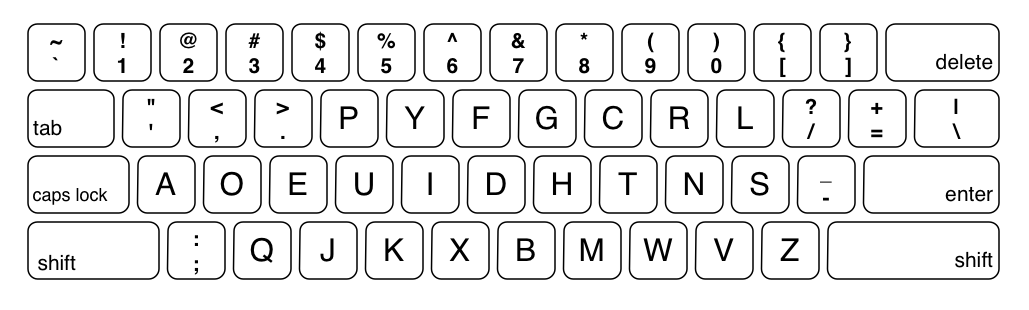
If maximizing alternation were naturally a fifty-fifty proposition, the layout Dvorak actually built after all that filming and counting would be split down the middle. It is not. Vowels — a, o, e, u, i — sit on the left side of the Dvorak home row, with the most common consonants — d, h, t, n, s — on the right, and the skew continues off the home row: p and y join the vowels on the left, while f, g, c, r, and l join the consonants on the right (see the Dvorak Simplified Keyboard). Counting only the 26 letters, Dvorak’s left hand carries eleven and its right carries fifteen — not thirteen and thirteen. Run that exact split against the 61,289-word list used throughout this piece and it alternates hands on 70.23% of adjacent letter pairs: a striking result for an assignment worked out with film stock and hand-counted letter tables, decades before anyone could brute-force the alphabet on a computer, and a full 3 points ahead of Halmak, a layout explicitly “AI designed” in 2019 by a genetic algorithm trained on real hand-movement data, which lands at 67.24% while holding to a symmetric 13/13 split.
QWERTY itself isn’t symmetric either, though not by design: fifteen letters on the left (q w e r t a s d f g z x c v b), eleven on the right (y u i o p h j k l n m), a byproduct of whatever mix of mechanical and telegraphic pressures actually shaped it. Colemak, built as a minimal-change successor to QWERTY, inherited the identical 15/11 shape with different letters in it. Arno Klein’s Engram project — a more recent, peer-reviewed effort in the International Journal of Human-Computer Interaction that, like Dvorak, clusters vowels together specifically to improve hand alternation — comes out at 68.24% on an early full-alphabet mapping tested here, on a 12/14 split. Every serious, independently-built letter-to-hand assignment in a hundred and fifty years of keyboard history — inherited from a jamming typebar or a telegraph desk, hand-tuned with slow-motion film, minimally patched from its predecessor, peer-reviewed, or bred by a genetic algorithm — has come out lopsided. The fifty-fifty split that today’s split ergonomic keyboards take for granted has no ancestor in this lineage. It came from somewhere else.
Then two keywells showed up
Every layout in the previous section — QWERTY, Dvorak, Colemak, Engram, even Halmak’s computed one — was designed to sit on a single, continuous row of keys. “Left hand” and “right hand” were bookkeeping: a fact about which key a typist’s hand happened to reach for, not a boundary the keyboard itself enforced. Nothing about that hardware cared whether eleven keys or fifteen sat on either side of an imaginary line down the middle of the space bar, so nothing pushed any of these designers toward symmetry, and none of them landed there.
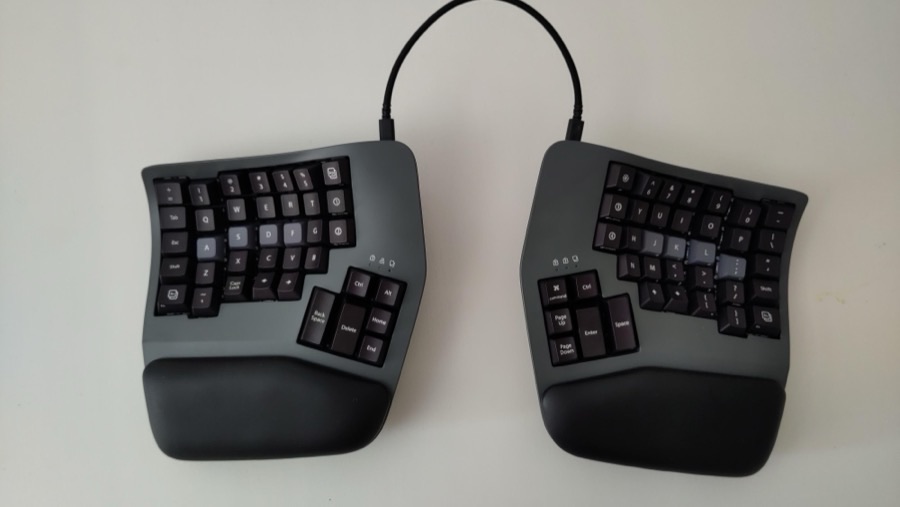
A physically split ergonomic keyboard changes what kind of decision a hand-split is. The Kinesis Advantage360, the ErgoDox, the Moonlander, and open-source column-stagger boards like the Corne — commonly built as “6×3+3,” six columns and three rows of letters per hand plus a three-key thumb cluster — are two separate, mechanically identical keywells, each with its own controller, sold and assembled as mirror images of each other. On hardware like that, “how many keys does each hand get” stops being a question the layout answers on its own and becomes a question the case design answers first, months before anyone chooses where a single letter goes. Building both halves from the same tooling, the same PCB, the same firmware, and letting the software decide which half handles which letters, is a reasonable manufacturing decision. It has never been an ergonomic one. It just quietly became the assumption every layout designer working on a physically split board has had to design inside of, whether or not the split that best serves their stated goal needs the same number of keys on both sides.
What a brute-force search over 61,000 words finds
The question this piece actually set out to answer is narrower than a full keyboard layout: not where every letter sits or which finger reaches for it, just which of the ways to split the alphabet into a “left” set and a “right” set alternates hands the most, typing ordinary English. The method is exhaustive, not heuristic: for every split size from 1 to 13, try every combination of that many letters as the smaller side, score each candidate by counting, across the word list, how many adjacent letter pairs within a word land on the same side, and keep the split with the fewest same-hand collisions. Splits of size 14 through 25 mirror splits of size 12 down to 1 — swapping which set gets called “left” doesn’t change the count — so sizes 1 through 13 already cover every possible way to split the alphabet in two.
One methodological choice matters more than it looks: the word list is unweighted. Each of the 61,289 entries counts once, whether it is the or acetate, instead of being weighted by how often it occurs in ordinary text. That is exactly the property argued for above — it is what lets the search protect words a frequency-weighted corpus would never see enough of to protect on purpose.
The result is a clean, U-shaped curve, and its minimum is not at 13:
| Split (smaller / larger) | Same-hand collisions | Alternating |
|---|---|---|
| 1 / 25 | 345,786 | 23.57% |
| 2 / 24 | 265,909 | 41.22% |
| 3 / 23 | 203,598 | 55.00% |
| 4 / 22 | 158,068 | 65.06% |
| 5 / 21 | 135,505 | 70.05% |
| 6 / 20 | 127,791 | 71.75% |
| 7 / 19 | 125,367 | 72.29% |
| 8 / 18 | 124,926 | 72.39% |
| 9 / 17 | 125,252 | 72.31% |
| 10 / 16 | 126,043 | 72.14% |
| 11 / 15 | 127,000 | 71.93% |
| 12 / 14 | 128,423 | 71.61% |
| 13 / 13 | 131,122 | 71.02% |
The curve falls steeply as the smaller side grows from one letter to about seven, flattens, bottoms out at eight, and climbs again, slowly, all the way through thirteen — the one split size every physically symmetric keyboard is built to require. The best 13/13 split found by the same search — {y e u i h k q g z a o j x} against {p d r w c m n t b f s l v} — alternates on 71.02% of transitions and still leaves four words of six letters or more (haggai, hookah, zigzag, zigzaggy) entirely one-handed. The global optimum — e, a, o, k, g, u, y, and i on the smaller side, the other eighteen letters on the larger one — reaches 72.39% and leaves none. The percentage-point gap between the two is a real, measurable cost of insisting on symmetry: about 6,200 avoidable same-hand collisions across this one word list, or, in an actual working day, however many keystrokes it takes before that adds up to something a wrist notices.
Set against real, named layouts, the same scorer gives a fuller picture of where the field currently stands:
| Layout | Split | Alternating | 6+-letter one-hand words |
|---|---|---|---|
| QWERTY | 15 / 11 | 47.31% | 1,007 |
| Colemak | 15 / 11 | 56.38% | 96 |
| Engram (early mapping) | 12 / 14 | 68.24% | 15 |
| Halmak | 13 / 13 | 67.24% | 49 |
| Dvorak (1936) | 11 / 15 | 70.23% | 4 |
| Best possible, symmetric | 13 / 13 | 71.02% | 4 |
| Best possible, unconstrained | 8 / 18 | 72.39% | 0 |
One more data point, less rigorous but closer to home: one of us has been hand-tuning a 13/13 candidate toward an actual physical build, trading a little of the theoretical maximum for letters that sit in more sensible finger columns. It currently alternates on 70.54% of transitions — ahead of Halmak, behind Dvorak by a hair, and half a point under this search’s own 13/13 ceiling. Whether that half a point is worth chasing before cutting a PCB is exactly the kind of trade-off the next section returns to.
What the answer looks like as a keyboard
The two hand-sets the search converged on — e, a, o, k, g, u, y, i on one side; the other eighteen letters on the other — can be laid out as two ortholinear blocks, no stagger, one key per grid cell, the same geometry column-stagger split keyboards already use:
| i | u | y |
| e | a | o |
| g | k |
| l | c | m | w | f | p |
| t | n | s | h | r | d |
| b | v | x | j | q | z |
None of this is a finished keyboard. The search answers one narrow question — which letters should share a hand — and deliberately ignores everything else a real layout has to weigh: same-finger bigrams within a hand, finger strength, which specific column sits at a wrist-friendly angle. Concentrating eighteen letters on one hand could just as easily reintroduce a different cost inside that hand — more same-hand, same-finger repeats, more total travel — that a real build would have to solve for before it printed a case. Whether the true answer is the full 8/18 split, or something closer to Dvorak’s ninety-year-old 11/15 compromise, which already captures most of the available gain without asking one hand to carry eighteen keys, is a design decision this piece doesn’t make.
What the search does settle is smaller, and harder to dismiss: nobody who has ever actually optimized a keyboard layout for typing English — not in 1936 with slow-motion film, not with a modern peer-reviewed n-gram study, not with a genetic algorithm, not with a brute-force search over 61,000 words — converged on giving each hand the same number of letters. The closest any of them comes is Halmak’s 13/13, and it pays for that symmetry with a worse alternation score than a layout designed decades before computers existed to help. The fifty-fifty split shows up exactly once in this entire history, and it shows up in the hardware, not in anyone’s typing data. A split ergonomic keyboard that actually wanted to maximize alternation would probably have to look uneven on purpose — and that only sounds strange because every case sold so far was cut the other way.
References
- Dvorak, Dealey, Merrick & Ford. Typewriting Behavior. 1936 — the book that introduced the Dvorak Simplified Keyboard, via Wikipedia; design-goal quote via History of Information.
- Dvorak keyboard layout. Wikipedia — the letter-to-hand assignment used here.
- Colemak. Design methodology.
- kaievns. Halmak: the final version of the AI designed keyboard layout. GitHub, 2019.
- Klein, A. Engram keyboard layout. Peer-reviewed as “Optimizing comfortable keyboard layouts using human typing preferences and language-dependent n-grams: the Engram Study,” International Journal of Human-Computer Interaction, 2026.
- Cerni, T., Longcamp, M., & Job, R. Two thumbs and one index: A comparison of manual coordination in touch-typing and mobile-typing. Acta Psychologica, 2016.
- The QWERTY Keyboard Will Never Die. Smithsonian Magazine — on the disputed origins of the QWERTY arrangement.
- Kinesis Advantage360. Product page — a physically split, mirrored ergonomic keyboard.
- Klam, J. Six Months with a Corne Keyboard. — on the Corne’s 6×3+3 per-hand geometry.
- Letter frequency. Wikipedia — used for the illustrative within-hand row placement in the keyboard mockup.
- Zipf’s law. Wikipedia.
- All alternation scores and word counts in this piece were computed directly, using a brute-force search (
itertools.combinationsover the alphabet) against a 61,289-word English word list, for this piece.